My talk on tracking Artemis II with a planet-wide network of open sensors won third place in the student oral competition at NASA's Exploration Science Forum, where I was the only high-school student in a field of graduate and early-career researchers giving oral talks.
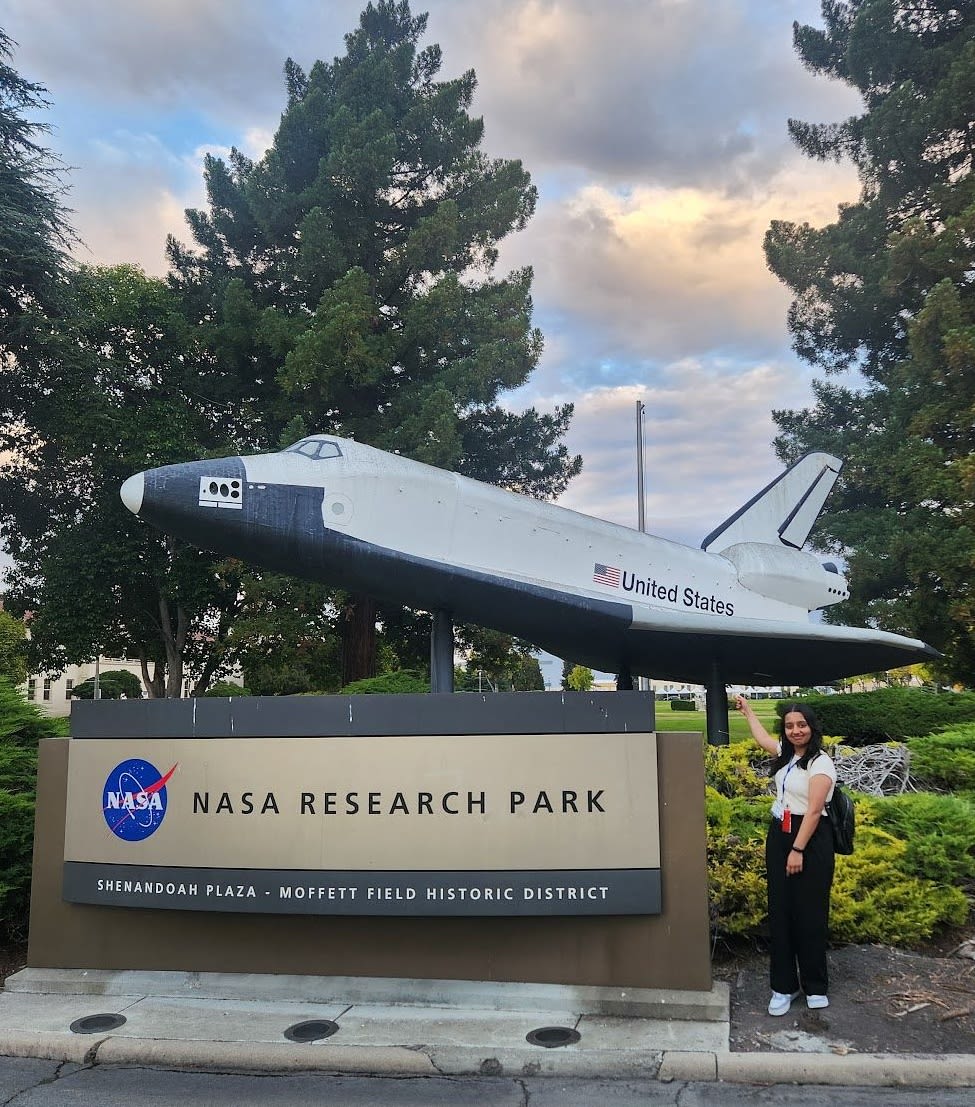 At NASA Ames Research Center, beside the 36%-scale Space Shuttle orbiter model once tested in the centre's wind tunnels
From 21 to 23 July 2026, I presented my research at the NASA Exploration Science Forum (NESF) at NASA Ames Research Center in California. My oral talk, "Project MOON: Scalable Open-Data Framework for Autonomous Multi-Sensor Detection of Artemis Launch Signatures," presented the results of my work tracking the Artemis II mission throughout its 10-day journey using open satellite, seismic, infrasound, and telescope data. I spoke during the Applications of AI/ML in Space and Planetary Science session, alongside researchers developing autonomous lunar rovers, spacecraft fault-diagnosis systems, machine-learning methods for lunar mapping, and data-driven mission-planning tools.
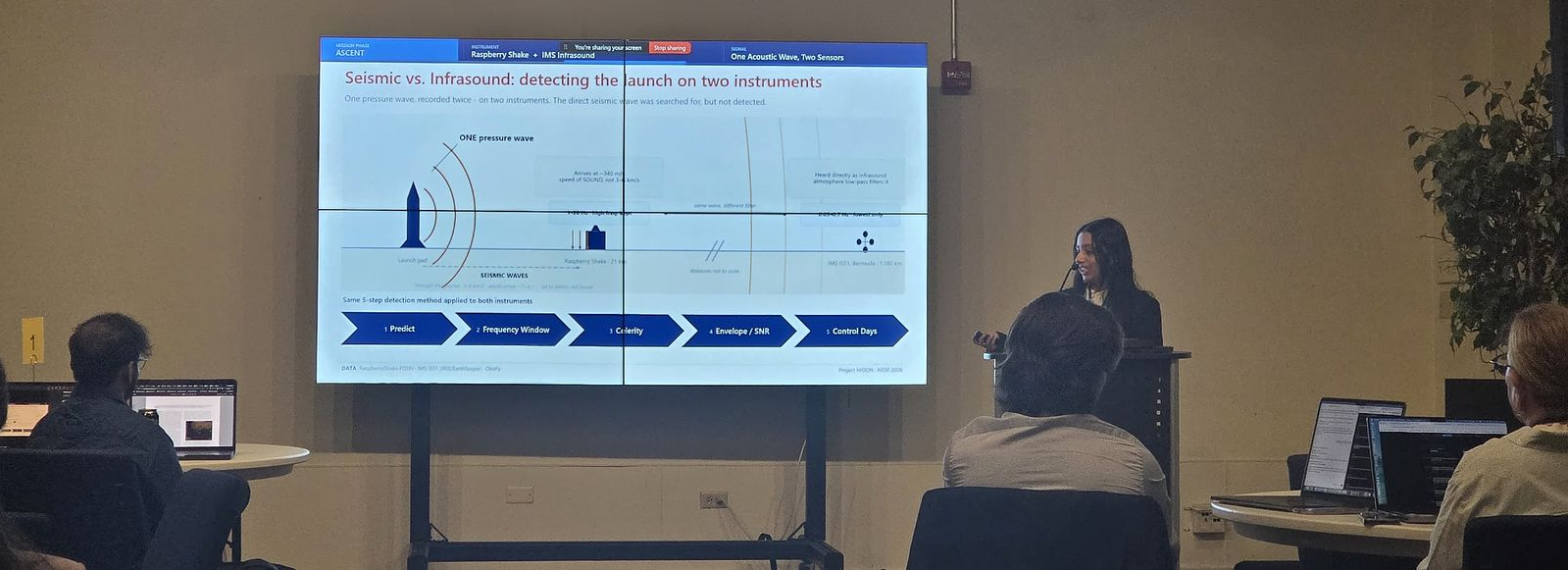 Presenting Project MOON during the Applications of AI/ML in Space and Planetary Science session: detecting the Artemis II launch on two independent instruments, a Raspberry Shake seismometer and an IMS infrasound station.
At the closing ceremony, I was honoured to receive third place in SSERVI's student oral presentation competition. The competition is judged by a committee of scientists and SSERVI management on the originality and impact of the research, the rigour of its results, and how clearly it is communicated to a non-expert audience, and third place carries a $1000 travel grant. Oral presentation slots were limited, and most contributions at the forum were presented as posters, so being selected to give a talk was an achievement in itself. As the only high-school student among the graduate students and early-career researchers giving oral talks across lunar science, AI, autonomy, and mission engineering, the recognition was especially meaningful.
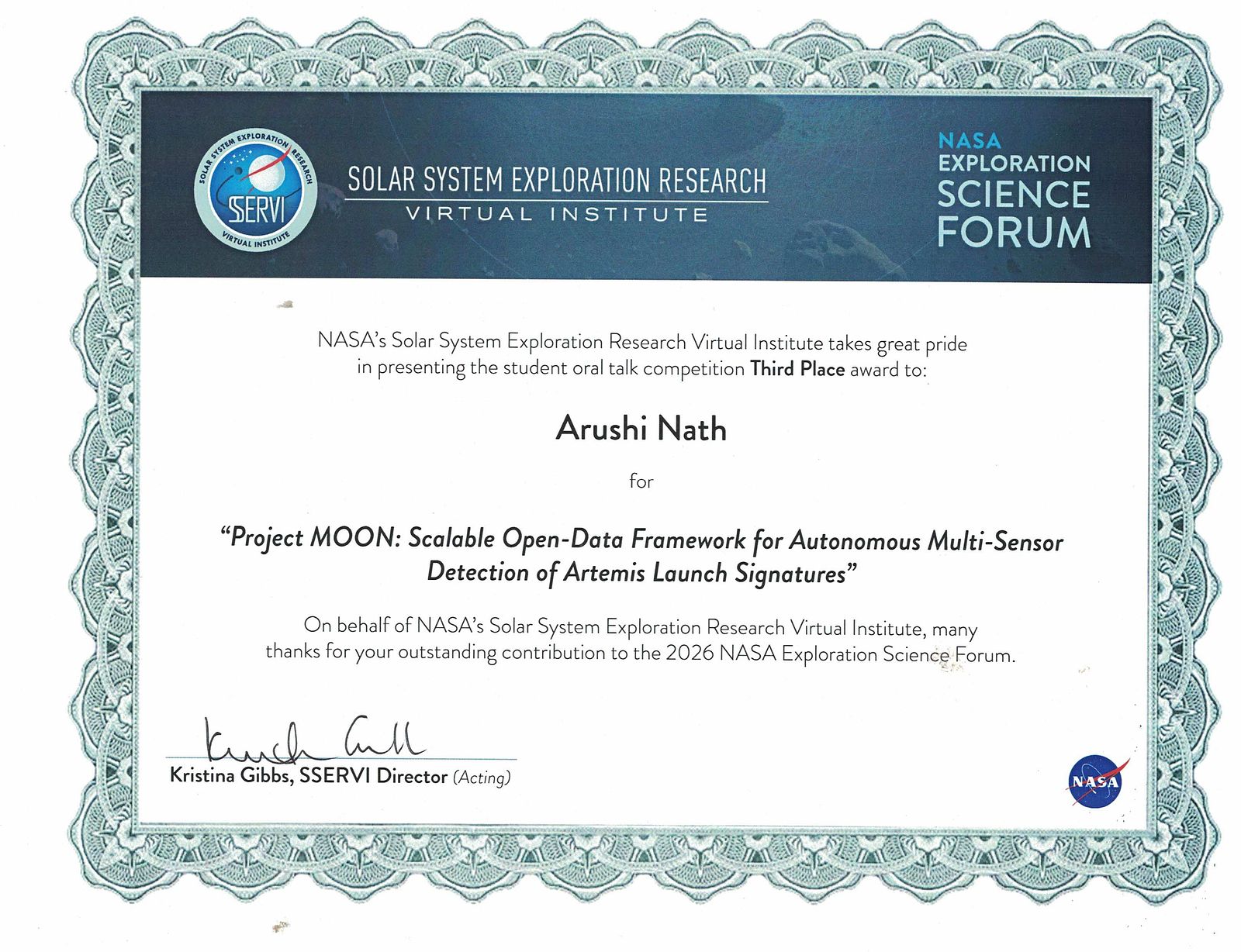
My third-place certificate from the NASA Exploration Science Forum student oral competition, awarded by SSERVI for Project MOON.
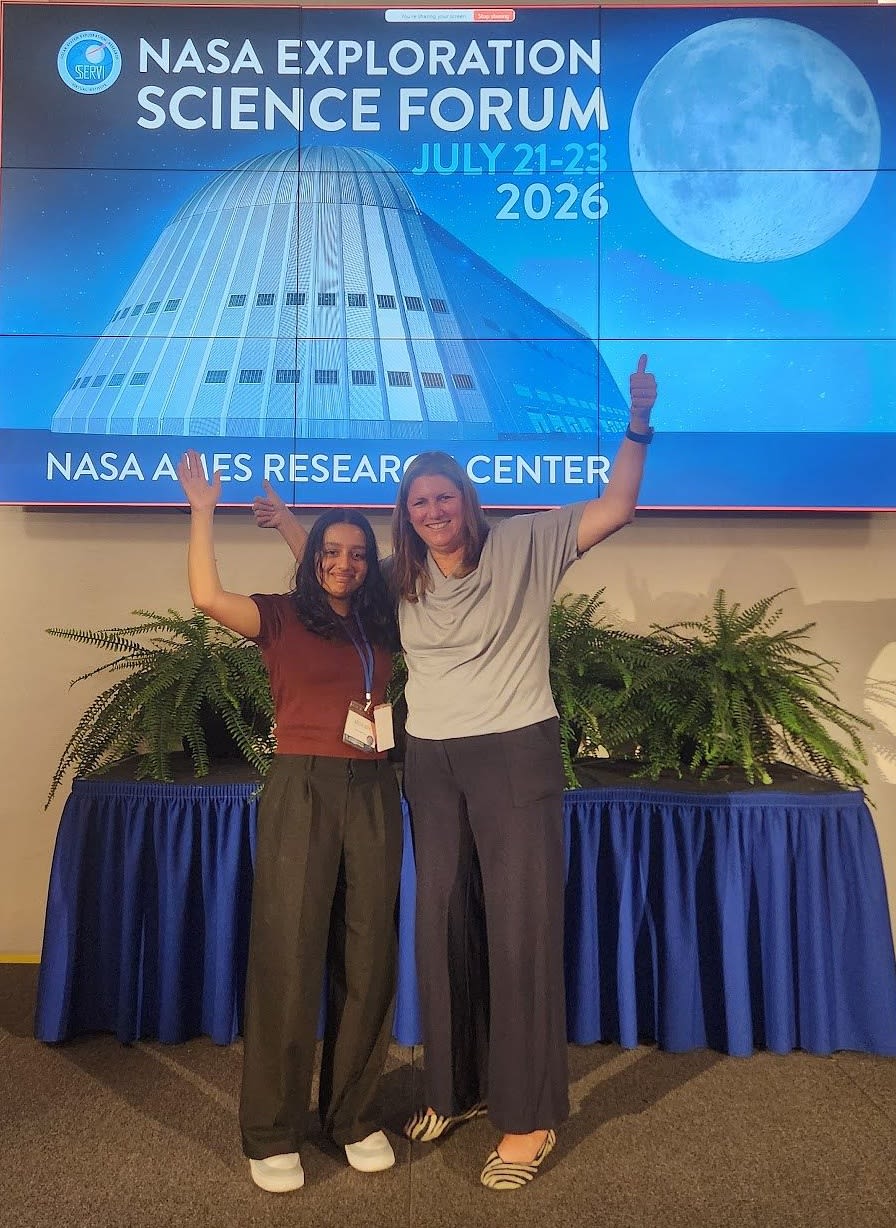 Celebrating third place in the student oral presentation competition with SSERVI Deputy Director Kristina Gibbs at the NASA Exploration Science Forum.
Organised by NASA's Solar System Exploration Research Virtual Institute (SSERVI), NESF connects lunar and planetary science with the practical challenges of exploration. The forum brought together scientists, engineers, mission planners, students, and industry leaders working across lunar surface and planetary exploration to discuss how science will shape the Artemis era. The 2026 programme covered lunar infrastructure, astronaut science operations, water-ice exploration, autonomous systems, sample science, and technologies for a sustained human presence on the Moon.
Project MOON in Brief
Project MOON (Monitoring Orion through Open-data Networks) began with a personal connection to Artemis II. In 2017, when I was eight years old, I visited the Canadian Space Agency and met several Canadian astronauts, including Jeremy Hansen. When he was later selected to fly around the Moon as an Artemis II mission specialist, I challenged myself to follow the mission from Toronto using only publicly accessible instruments, datasets, and software. Rather than relying on a single observatory, I treated open sensor networks distributed across the planet as one large scientific instrument.
The resulting framework followed Artemis II through nearly every phase of its journey. Sentinel-2C imagery captured the Space Launch System on the launch pad two days before liftoff, while infrared observations from GOES-19 detected the ignition flash from geostationary orbit. Raspberry Shake seismometers recorded air-coupled ground motion near Kennedy Space Center, and the IS51 infrasound array in Bermuda detected long-range atmospheric signals arriving from the direction of the launch. During cruise, robotic telescopes in Chile, Spain, and Australia tracked Orion across eight nights and 465 images, measured its changing angular motion, resolved its separation from the Interim Cryogenic Propulsion Stage, and revealed the stage's approximately 22-minute tumbling period. The observations continued until 17 hours before splashdown, when Orion was approaching Earth again after travelling more than 400,000 kilometres away. More about Project MOON is available at monitormymoon.com.
 My planet-scale instrument, phase by phase: which sensor caught Artemis II at each stage, from the rocket on Pad 39B to splashdown, with the open datasets and tools behind each. (Slide from my NESF talk.)
 The results scorecard from my talk: every detection cross-checked against ground truth, including the two attempts that did not work. (Slide from my NESF talk.)
Presenting this work at NESF also meant hearing how researchers across the community are wrestling with the same questions that shaped Project MOON: how to turn missions into open, connected data; how AI and autonomy can support exploration; and how access to science can be widened. Three threads from the forum stood out to me.
Missions as Open, Multi-Sensor Data
Project MOON treats a mission as something the whole planet can observe and analyse, so the talks on turning Artemis operations into scientific data resonated most directly with my work. The Artemis Era session showed that collecting data during a mission is only the first step. Images, astronaut observations, video, and instrument measurements must also be organised and made useful for scientists after the mission ends.
Benjamin Fernando examined whether impact flashes reported by Apollo astronauts could be linked with corresponding signals in lunar seismic records. His team searched Apollo seismic data for signals associated with three astronaut-reported flashes but found no candidate matches. Although the result was negative, the work established a reusable pipeline for coordinating astronaut observations with lunar seismology. For Artemis II, the team is also comparing crew-reported flashes with expected impact rates and citizen-science observations from ground-based telescopes. These combined observations could eventually constrain impact dynamics, the conversion of impact energy into light and seismic waves, and hazards from high-speed ejecta.
The same multi-sensor thinking is being extended to the lunar surface itself. Zhongwen Zhan presented lunar distributed acoustic sensing, which would use long fibre-optic cables as dense seismic arrays to investigate buried ice and characterise potential landing sites.
Anna Najafi demonstrated the data-organisation challenge using Apollo records. Information about individual samples was often scattered across photographs, timelines, transcripts, videos, and handwritten logs. Her team developed a searchable database that connects each image to its location, sample, and scientific purpose, reducing searches to a matter of seconds. The project is also helping identify how Artemis crews can document their work more consistently from the beginning. Ariel Deutsch described how the Artemis II Lunar Targeting Plan combined priority targets, camera instructions, visual guides, and mission constraints while still allowing the crew to react to unexpected features, and Zachary Morse used video from suit-mounted cameras to reconstruct astronaut paths and create three-dimensional terrain models through photogrammetry and Gaussian splatting.
Together, these talks emphasised that future missions must plan not only what data to collect, but also how those data will be labelled, connected, preserved, and analysed. Better documentation and data systems can expand the scientific value of observations that astronauts and spacecraft are already making.
The poster session in Hangar One extended this theme across a wide range of lunar and planetary research. One poster examined how the viewing angle of Mini-RF radar observations affects measurements of lunar backscatter and surface roughness. Another studied how OH and H₂O absorption features at lunar silicic constructs change over the course of the lunar day, helping distinguish real hydration variations from thermal effects. A third focused on electrostatic charging mechanisms at the lunar surface and how uncertain surface potentials affect dust motion, instruments, and future exploration systems. Another presented laboratory measurements of particles returned from asteroid Bennu, including their surface composition, sulphur chemistry, and the effects of exposure to Earth's atmosphere. Discussing these projects with the researchers helped me better understand how each method can answer different questions about the Moon and other planetary bodies.
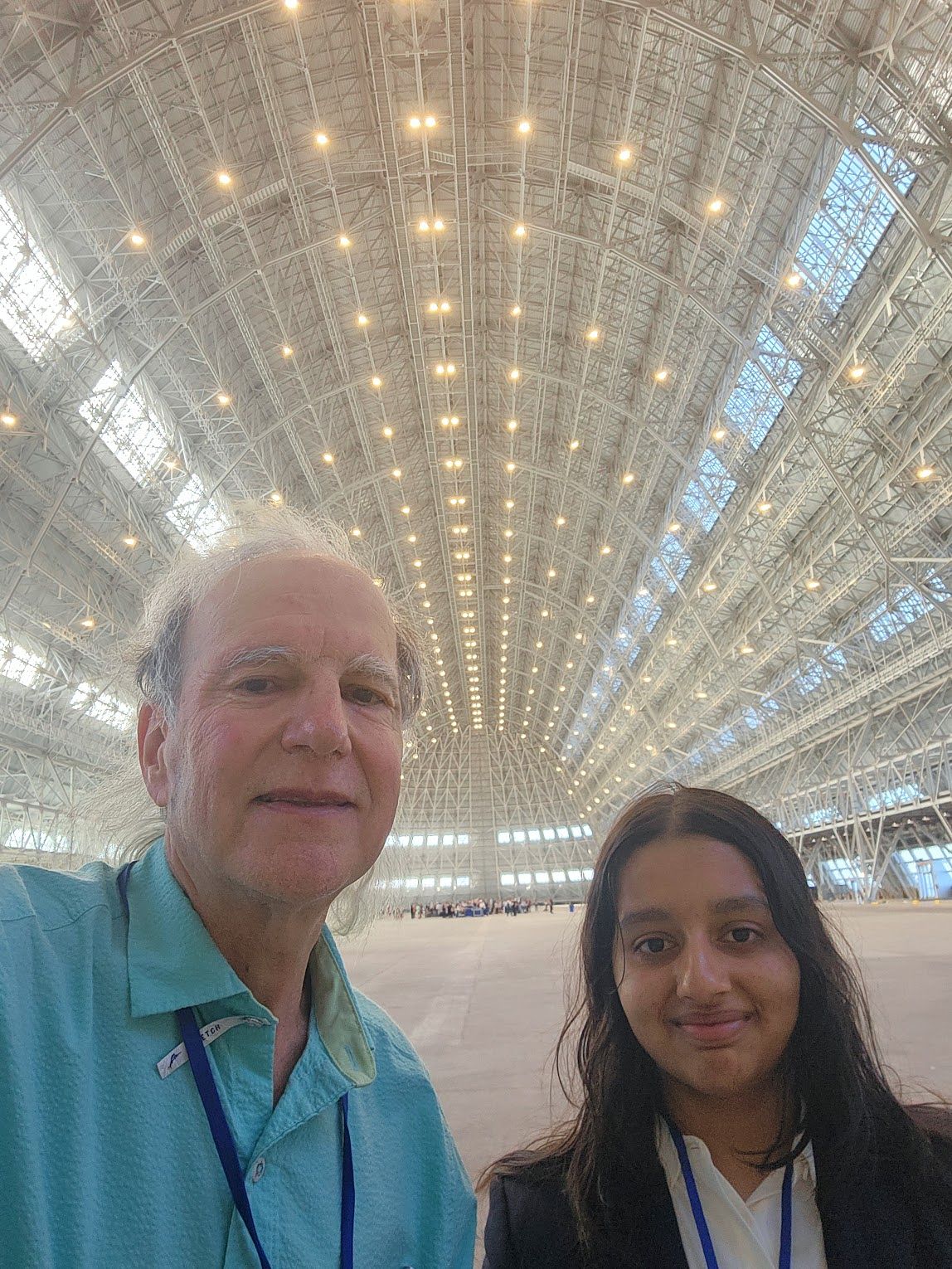 Talking through posters in Hangar One with Dr. Jack Lissauer of NASA Ames during the NESF poster session
AI and Autonomy for Exploration
I presented Project MOON during the Applications of AI/ML in Space and Planetary Science session, which explored how future missions could operate with less continuous guidance from Earth.
Federico Lozano Cuadra discussed foundation models for autonomous lunar rover teams, Sourabh Shubham used unsupervised clustering to identify spectrally similar regions of the Moon, and Kazuki Toma presented a system for generating possible explanations when traditional spacecraft fault-detection methods encounter an unfamiliar problem.
Natalie Gallegos demonstrated how NASA's Moon Trek platform combines elevation, slope, rock, crater, lighting, and communications data to plan safer rover routes. Together, the talks in my session showed that AI is most useful not as a replacement for mission teams, but as a tool for processing complex datasets and supporting decisions when immediate guidance from Earth is unavailable.
 Natalie Gallegos giving a live demonstration of NASA's Moon Trek route-planning platform during the AI/ML session
Autonomy is also central to the lunar surface itself. Kristen John connected the Artemis architecture needs to the technologies being developed for the surface, including autonomous excavation, robotic construction, dust mitigation, power generation and distribution, energy storage, and thermal-control systems. Many of these systems are intended to operate before or alongside astronauts, creating infrastructure that allows future crews to spend more time conducting science rather than maintaining basic capabilities.
Science Drives Exploration, and Access Widens It
Kristina Gibbs, Deputy Director of NASA's SSERVI, opened the conference by introducing the history of Ames, Hangar One, and the surrounding Moffett Field site. One of the most visible reminders of that history was the recently restored Hangar One, the enormous former airship hangar that has stood at Moffett Field since the 1930s. Near the centre's entrance was another link to NASA's past: a 36%-scale model of the Space Shuttle orbiter, tested in the wind tunnels at Ames to study the Shuttle's aerodynamic performance.
NASA Ames Center Director Eugene Tu continued this theme by reflecting on Ames' long-term evolution. Ames began primarily as an aeronautics research facility, but its work has since expanded to include planetary science, astrobiology, advanced computing, autonomous systems, and human exploration. Tu described Ames as NASA's newly designated Innovation Center of Excellence and emphasised that some of the strongest advances occur when disciplines intersect. Wind tunnels originally built to study aircraft can also be used to test spacecraft and parachutes. Aeronautics research supports Earth science, while exploration creates new opportunities for scientific discovery. His central message was that science drives exploration, and exploration enables science. That message became a recurring theme throughout NESF. The conference was not just about reaching the Moon and developing new spacecraft; it was about determining which scientific questions should guide exploration, what technologies are needed to answer them, and how discoveries made can reshape our understanding of the Moon, Earth, and the wider Solar System.
The NASA leadership updates showed that sustained lunar exploration will require frequent access to the Moon, reliable funding and partnerships, improved data systems, and technologies that connect scientific planning with human operations. Sarah Noble illustrated how quickly NASA's lunar science portfolio is expanding. Commercial Lunar Payload Services (CLPS) missions are expected to deliver instruments to the south polar region, the lunar farside, and Reiner Gamma, while long-running orbiters continue to provide the maps and measurements needed to plan future exploration. NASA has also selected additional commercial landers for missions later this decade, with the goal of making lunar access more frequent and dependable. More regular access could transform what lunar science is possible. Instead of waiting many years between major missions, researchers could send smaller instruments more often, respond more quickly to discoveries, and use early missions to reduce uncertainty before larger ones. At the same time, these commercial missions are very schedule-driven; instruments must be prepared quickly and cannot introduce changes that delay the lander, requiring NASA to balance the amount of science carried on each mission with the larger goal of establishing a reliable landing cadence.
Jacob Bleacher, NASA's Chief Exploration Scientist, explained that the revised Artemis III mission is planned to remain in Earth orbit and test rendezvous, proximity operations, and docking between Orion and NASA's commercial human-landing-system partners. Moving these operations into an earlier mission would allow NASA to identify problems before Artemis IV and Artemis V attempt crewed lunar landings. Bleacher also explained the vision for a Moon base, developed gradually, beginning with providing landing systems and then expanding reusable infrastructure, surface access, and the amount of equipment that can be delivered. One of the most important ideas from his presentation was that sustained lunar exploration depends on closing architecture, data, and technology gaps. NASA must determine how equipment will be transported, stored, powered, and protected, while improving imagery and topographic data for landing-site selection and surface navigation. It must also better understand where lunar water ice is concentrated, how it is distributed beneath the surface, and whether it can be accessed efficiently. Together, these gaps will shape future infrastructure, scientific priorities, and decisions about how to use lunar resources.
 Jacob Bleacher, NASA's Chief Exploration Scientist, on the revised Artemis III plan and closing the architecture, data, and technology gaps needed for a sustained return to the Moon
Project MOON is built entirely on open, publicly accessible data, so the presentations on widening participation felt especially close to my own approach. Carla Mitchell presented Africa2Moon, an African-led lunar radio astronomy project built through international collaboration, volunteer expertise, and education programmes designed to develop a regional space workforce. Barbara Bruno and Nina Webb described ICE FIVE-O's "Going to the Moon and Beyond" programme for incarcerated learners in Hawaii, combining planetary science, hands-on activities, and Hawaiian cultural perspectives. Elise Rumpf also presented updates to the Terrestrial Analogs Data Portal, while a new planetary simulant database is helping researchers find, compare, and reuse data that might otherwise remain scattered across individual laboratories. Together, these projects showed that expanding access can mean creating pathways into missions, bringing science education to overlooked communities, and making research data easier for others to discover and use.
 With fellow student researchers at the NESF welcome reception
A Standout Moment: Meeting Artemis II Astronaut Victor Glover
One of the most memorable sessions at NESF was with Victor Glover, pilot of NASA's Artemis II mission, who spoke about the teamwork, communication, and human experience behind the journey. Glover emphasised that communication is the key to allowing scientists, engineers, astronauts, and mission teams to work effectively together. He described strong teams as ones that can disagree well and remain coachable. When asked what surprised him most about the Moon, he described being captivated by the lunar terminator, the boundary between light and darkness. Seen up close, it revealed the Moon's shadows and rugged terrain in a way that felt both scientifically fascinating and emotional. Glover closed with three lessons: resilience, lifelong learning, and being a good teammate. His presentation showed that exploration is not only about reaching new destinations, but also about how people learn, collaborate, and share those experiences with the world.
After the session, I had the opportunity to speak with Glover and share my Project MOON research on tracking Orion from launch to splashdown.
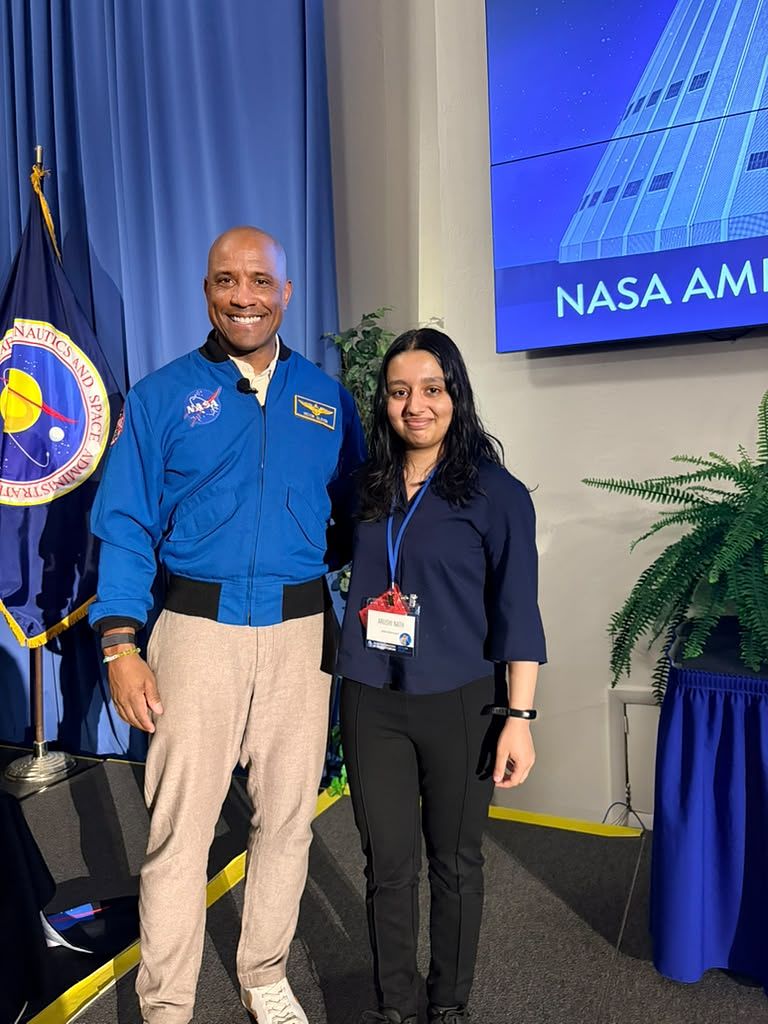 With Artemis II pilot Victor Glover, a crew member of the very mission Project MOON tracked
More from the Sessions
The breadth of NESF was one of its strengths, and many talks deserve a fuller record than the threads above can hold. Here are the other sessions I attended in more detail.
Reading the Moon's Geological Record
Several presentations focused on features that appear simple from orbit but reveal much more complex stories when their composition, structure, and subsurface properties are examined together.
Zachary Vig presented evidence that the Gruithuisen Domes may contain two distinct compositional units: a silica-rich interior covered by a more iron-bearing, possibly noritic layer. By combining spectral data with the locations of small impact craters, his team suggested that the brighter silica-rich material may lie beneath a variable crustal cover. The upcoming Lunar-VISE rover could test this by examining boulders, regolith, and crater ejecta across the domes.
Sonia Tikoo examined possible sources of lunar crustal magnetic anomalies. Although the Moon no longer generates a global magnetic field, portions of its crust retain ancient magnetisation. Her work emphasised that grain size and magnetic-domain state can be as important as bulk composition: fine-grained Fe-Ni metal can preserve much stronger remanent magnetisation than coarser grains. This may help explain how some lunar rocks or subsurface magmatic structures produced intense local magnetic anomalies.
Sean Lozano used young cold-spot craters around the Orientale basin to show that metre-scale rocks may remain widespread beneath the upper 10–15 metres of the lunar highlands, even where surface rock abundances differ.
Together, these talks showed why orbital measurements still require ground truth. Spectra, magnetic maps, thermal data, and crater observations can reveal patterns and identify promising hypotheses, but future rovers and astronauts will be needed to test what those signals represent on the surface. This combination of remote sensing and direct investigation will be essential for selecting samples, understanding terrain, and preparing scientifically valuable exploration missions.
Searching for and Preserving Lunar Water
One of the strongest themes of the second day was that detecting lunar water is only the beginning. Scientists must determine where it is concentrated, what form it takes, how deeply it is buried, and whether it can be extracted without being altered.
Mari Murillo searched Lunar Orbiter Laser Altimeter (LOLA) data for clusters of above-surface returns that could indicate suspended particles near the poles. The preliminary results showed unusual clustering near the south polar region, although more modelling is needed to determine whether volatile plumes could reach the required altitudes. Shuai Li reported differences in hydration between the northern and southern polar regions, while Janice Bishop presented evidence for both persistent water or hydroxyl bound within minerals and more mobile water that changes over the lunar day.
Other researchers focused on probing the subsurface directly. Isabel King described a heated drill designed to release volatiles while the material remains inside the borehole, while Benjamin Richardson presented a compact mass spectrometer for identifying compounds directly on the surface. Steven Dibb also showed how neutron detectors carried by hopping vehicles or integrated with drills could locate hydrogen-rich material and estimate how it changes with depth.
Charles Hibbitts then addressed what happens after a sample is collected. His cryogenic transfer system is designed to move future polar samples between laboratories without warming them, losing gases, or exposing them to Earth's atmosphere. Together, these talks outlined a complete chain from locating lunar water to extracting, identifying, and preserving it for detailed study.
Engineering for Lunar Dust and Regolith
The final day focused on one of the Moon's most persistent engineering challenges: its regolith. Lunar dust is abrasive, electrically charged, and easily transported, allowing it to coat instruments, damage mechanisms, reduce solar-panel performance, and complicate construction. Advik Vira presented simulations of how radiation and solar-wind particles create charge within realistic regolith grains, while Luca Scifoni showed that electrodynamic dust shields work best within specific frequency ranges. Annalise Cabra also demonstrated an electron-beam method that overcharges dust grains, creating repulsive forces strong enough to lift them from surfaces, including the more adhesive highlands simulant expected near the lunar south pole.
Other presentations focused on measuring dust directly in the lunar environment. Rachel Klima described how the Lunar Vertex rover will use a multispectral microscope to compare the texture, composition, and maturity of regolith inside and outside Reiner Gamma, helping test whether magnetic shielding, space weathering, or dust migration created its unusual bright patterns. The DUSTER experiment will similarly measure charged dust and plasma near the south pole. Together, these talks showed that lunar dust is not simply a maintenance problem; understanding how it charges, moves, and interacts with equipment will be essential for safe and sustained surface exploration.
Reconstructing the Moon's Formation and Interior
The Lunar Geochemistry and Geodynamics session examined how the Moon formed, differentiated, and developed its present-day crust and mantle. Thomas Kruijer discussed the formation and evolution of the urKREEP reservoir, while Wenhao Zhao revisited whether ages associated with the lunar magma ocean can constrain when the Moon formed. Brynna Downey explored lunar accretion from an initially vapour-rich disk, and Stephen Parman examined how asymmetric solidification of the magma ocean could help explain major compositional differences across the Moon.
Other talks used elemental and isotopic evidence to investigate the Moon's internal structure and volatile history. Kyeong Ja Kim presented global elemental and neutron mapping from the Korea Pathfinder Lunar Orbiter (KPLO), while Josh Wimpenny used zinc isotopes to study the origin of lunar volatiles. Nicholas Dygert reconstructed the mantle sources of mare basalts using neodymium and hafnium isotopes, connecting samples erupted at the surface to processes deep within the Moon. Together, these studies showed how orbital maps, laboratory measurements, and returned samples can be combined to reconstruct events that occurred billions of years ago.
Looking Ahead: From Artemis II to Artemis III
Nine years after meeting Jeremy Hansen at the Canadian Space Agency, I arrived at NASA Ames having followed Artemis II across its journey around the Moon. NESF showed me that a mission does not end when a spacecraft lands or a dataset is collected. Its scientific value depends on the systems built around it: the people who ask the questions, the instruments that record the signals, the software that connects observations, and the communities given access to the results. I now plan to take Project MOON further in three directions. First, I want to build an open-source toolkit so that students and citizen scientists everywhere can track missions themselves, using the same open sensor networks and analysis pipeline I developed. Second, I plan to create a website that crowdsources results, so that observations gathered by many people around the world can be combined into a single shared record of a mission. Third, I want to bring in more open data sources, such as wind data, to track missions more completely and improve Project MOON's measurements. My aim is to have this framework ready for students and citizen scientists to use in tracking Artemis III.