Key achievements
- NASA Group Achievement Award (2025), DART Period Change Determination Team
- Eight sole-author refereed papers, including Acta Astronautica at age fifteen; co-author in The Planetary Science Journal (DART/Didymos) and The Astrophysical Journal Supplement (ExoClock)
- First published rotation period of potentially hazardous asteroid 2025 FA22, adopted by a polarimetry team in Astronomy & Astrophysics
- Second Prize, EUCYS 2023 · Third Grand Award, ISEF 2025 · Best Project Award, Canada-Wide Science Fair 2022 and 2023 · Third Place, NASA Exploration Science Forum student orals 2026
- Masason Foundation Scholar (Japan)
My observatory
I built and run research observatory R60 at a dark-sky site in Nerpio, Spain, operating it remotely from Toronto with Masason Foundation funding. The Minor Planet Center assigned it observatory code R60, ExoClock accepts its transit photometry for ESA’s Ariel mission, and its engineering is published in the August 2026 Journal of the RASC.
Ongoing research
- Planetary defence: rotation periods, shapes, binary companions and taxonomy of near-Earth and potentially hazardous asteroids. My AT-LAST pipeline recovered 523 rotation periods from 5,052 asteroids in Rubin Observatory data, agreeing with published values 97% of the time.
- Exoplanets: refining transit ephemerides for ESA’s Ariel mission through ExoClock, and using my NEPTUNE N-body pipeline to find unseen planets from transit-timing variations.
SOLE-AUTHOR JOURNAL PUBLICATION · Observatory Engineering, Journal of the Royal Astronomical Society of Canada 120(4)
Building My Remote Observatory at 15: Engineering for Millimagnitude Photometric Precision
Arushi Nath · 12 August 2026
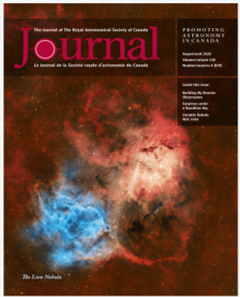
The August 2026 Journal of the Royal Astronomical Society of Canada published my article on my R60 observatory (the robotic 12-inch Ritchey–Chrétien telescope) I specified in Nerpio, Spain, and operate from my home. The article documents how my research proposal to strengthen planetary defense against near-Earth asteroids and accelerate the search for multiplanetary exoplanet systems won a "research grant" from Masason Foundation. Over several months, I researched the best specifications for my telescope's optical train, mount, and cameras to meet the science requirement of 0.001-magnitude photometric precision. I procured the equipment, unashamedly asking for equipment donation or student discount, from the vendors. Once assembled, I configured the tracking and guiding, and finally calibrated the instrument using darks and flats. Two independent organisations validated the results my observatory produces. The IAU Minor Planet Center (MPC) accepted my astrometric observations of asteroids and assigned observatory code R60 to my robotic telescope. The ExoClock accepted my photometric observations to improve transit ephemerides for European Space Agency's Ariel mission.
RUBIN COMMUNITY WORKSHOP · Asteroid Rotation at Survey Scale
Presenting AT-LAST, My Asteroid Rotation Pipeline, at the Rubin Community Workshop 2026
Arushi Nath · 27–31 July 2026
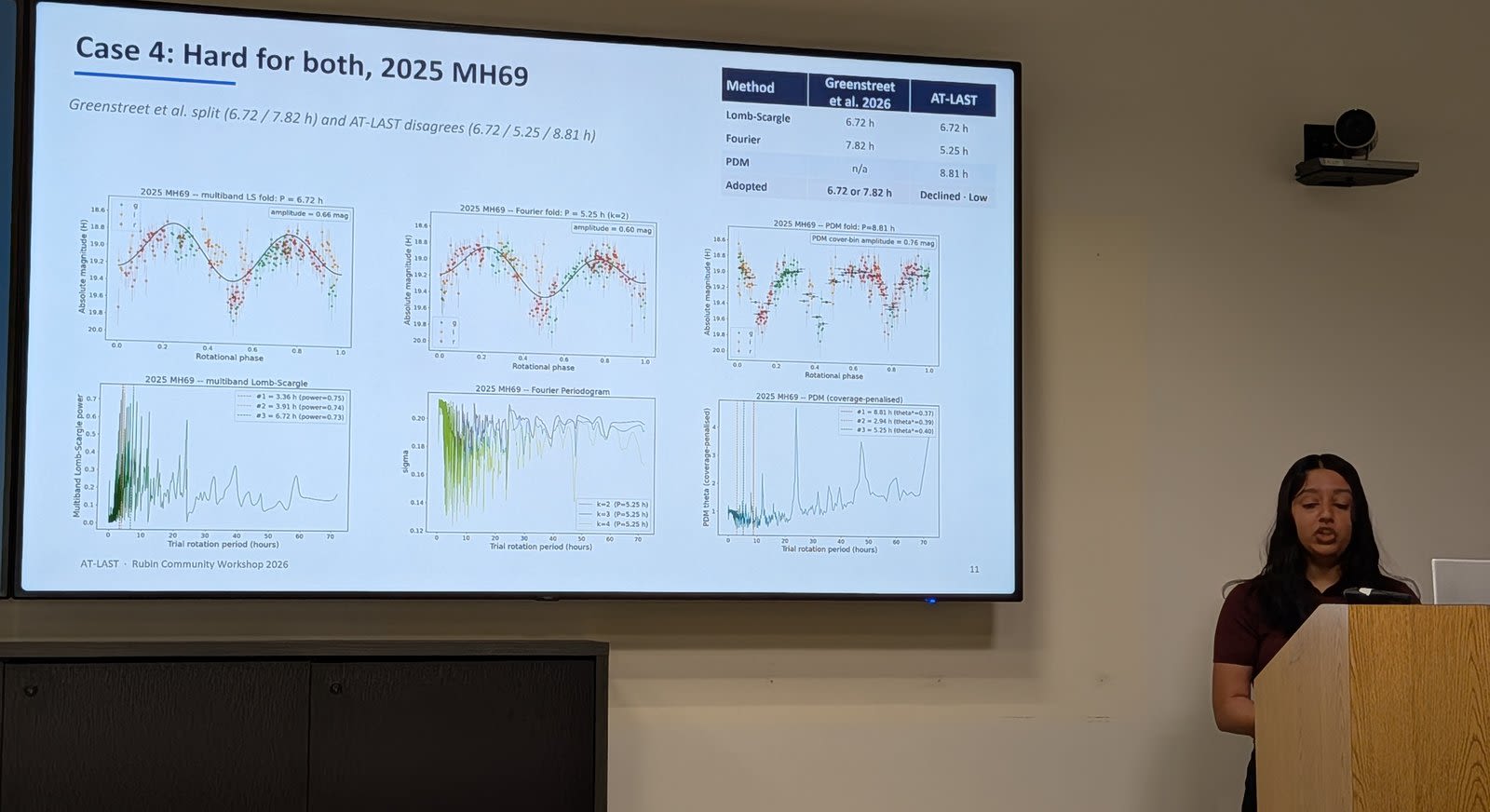
At the 2026 Rubin Community Workshop at SLAC National Accelerator Laboratory, I presented AT-LAST, my automated pipeline that turns the Vera C. Rubin Observatory's sparse survey photometry into reliable asteroid rotation periods. Run across 5,052 asteroids from Rubin's first look and DP2 datasets, it identified 523 high-confidence rotation periods, and where earlier work had committed to a single published period, it agreed 97% of the time.
NASA EXPLORATION SCIENCE FORUM · Third Place, Student Oral Competition
Tracking Artemis II Through Open Science: Presenting Project MOON and Winning Third Place at NESF 2026
Arushi Nath · 21–23 July 2026
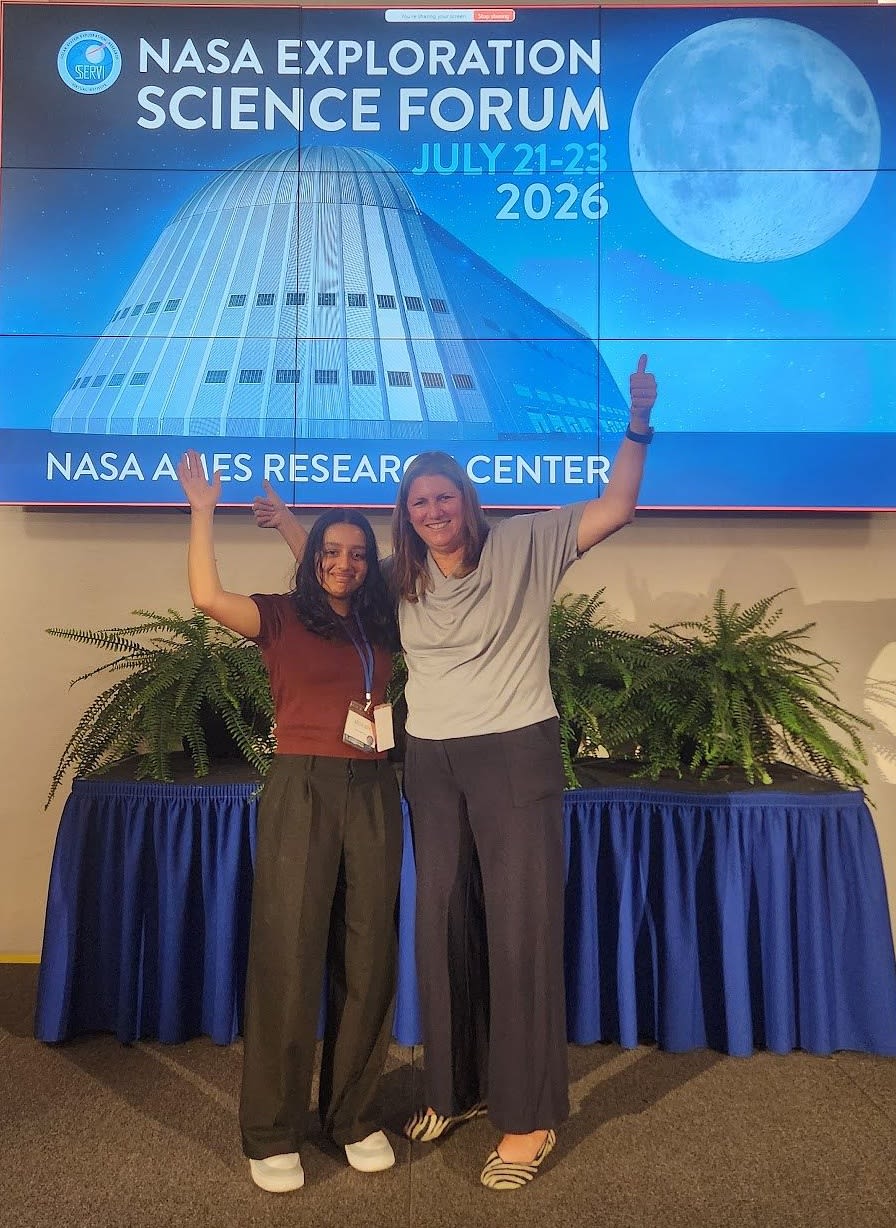
At NASA's Exploration Science Forum, I presented Project MOON (Monitoring Orion through Open Networks): tracking the Artemis II mission from launch to splashdown using open science alone, combining public tracking data, robotic-telescope imaging, and seismic and infrasound sensors. My talk won third place in SSERVI's student oral competition, and I was the only high-school student among the graduate and early-career researchers giving oral talks.
PLANETARY DEFENCE · JAXA Hayabusa2 Mission
Rotational Phase of Asteroid (98943) Torifune During Hayabusa2’s 2026 Flyby
Arushi Nath · 4 July 2026
On July 5, 2026, Japan's Hayabusa2 spacecraft raced past the near-Earth asteroid Torifune at 5 km/s, skimming within about a kilometre of a 450-metre rock we had barely seen. Torifune spins once every five hours, so the spacecraft only glimpses whichever face happens to be turned toward it. Using open public sky-survey data, orbital geometry, and algorithms, I predicted - before the flyby - which side the spacecraft would see, and showed why it should catch the asteroid at the shorter side. My prediction was public before the encounter; Hayabusa2's own images will settle whether I got it right.
RESEARCH OBSERVATORY · Engineering for Millimagnitude Precision
Building My Remote Observatory at 15: Engineering for Millimagnitude Photometric Precision
Arushi Nath · 28 May 2026
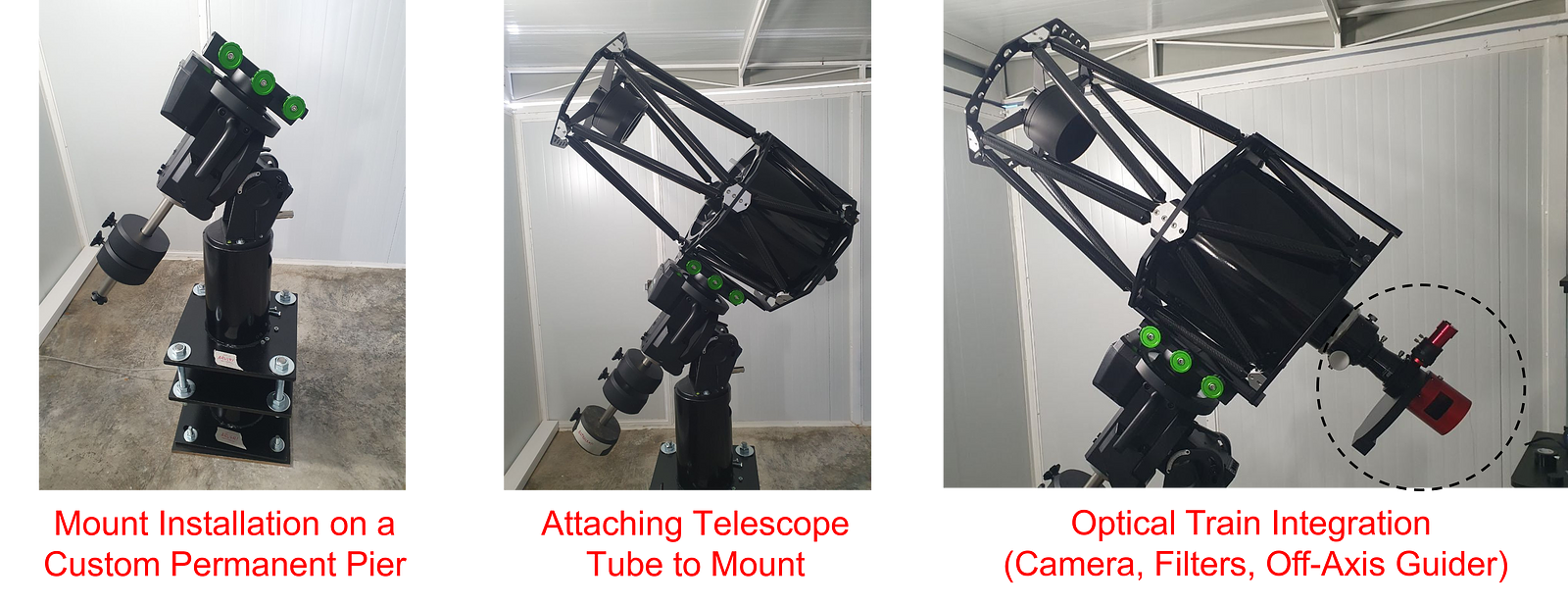
My 8 months project documentation on: how I built my research-grade remote observatory in southern Spain dark-night skies at fifteen to study near-Earth asteroids and multiplanetary systems: the engineering decisions behind millimagnitude photometry, the fundraising and Masason Foundation grant, debugging a loose screw 7,000 km away, and what the International Astronomical Union (IAU) Minor Planet Center code R60 now lets me contribute to planetary defence.
INTERNATIONAL TALK · Asteroid Shape & Spin Presentation
My Second Year at Kyiv's Young Scientists' Conference on Astronomy and Space Physics 2026: Presenting the Shape and Spin of Asteroid 2025 FA22
Arushi Nath · 28 April 2026
I presented my characterisation of newly discovered potentially hazardous asteroid 2025 FA22 at the Kyiv Young Scientists' Conference. From time-resolved CCD photometry I measured a rotation period of 13.075 ± 0.002 hours, a 0.62-magnitude double-peaked light curve indicating an elongated body, and multi-band BVRI colours consistent with an S-complex classification.
SOLE-AUTHOR PEER-REVIEWED PUBLICATION · Hazardous Asteroid Characterisation
Photometric Characterisation of Newly Discovered Potentially Hazardous Asteroid 2025 FA22
Arushi Nath · 15 April 2026
My photometric study of potentially hazardous asteroid 2025 FA22, published in the Journal of the Royal Astronomical Society of Canada, reports a 13.075 ± 0.002-hour rotation period, a 0.62-magnitude amplitude implying an elongated shape, and BVRI colours consistent with an S-complex classification.
CITIZEN-SCIENCE PROJECT · Tracking Artemis II From Earth
MonitorMyMoon.com: Tracking Artemis II from Launch Pad to Splashdown Using Open Science - From Toronto
Arushi Nath · 12 April 2026

INTERNATIONAL TALK · Asteroid Findings at LPSC
How I Characterised a Newly Discovered Potentially Hazardous Asteroid and Presented the Findings at the 57th Lunar and Planetary Science Conference (LPSC)
Arushi Nath · 30 March 2026
At the 57th Lunar and Planetary Science Conference (2026) I presented my characterisation of potentially hazardous asteroid 2025 FA22: a rotation period of 13.075 ± 0.002 hours, a 0.62-magnitude double-peaked light curve indicating an elongated body, and BVRI colours consistent with an S-complex classification, all from open ground-based photometry.
SOLE-AUTHOR PEER-REVIEWED PUBLICATION · Rotation Period of 2025 FA22
Lightcurve and Rotation Period of Asteroid 2025 FA22
Arushi Nath · 28 March 2026
I measured the shape and spin of newly discovered potentially hazardous asteroid 2025 FA22 during its September 2025 close approach: a 13.075 ± 0.002-hour rotation period and a 0.62-magnitude, double-peaked light curve pointing to an elongated body.
CO-AUTHOR PEER-REVIEWED PUBLICATION · Exoplanet Catalog
Co-author with A. Kokori et al.
ExoClock Project. IV. A Homogeneous Catalog of 620 Updated Exoplanet Ephemerides
Arushi Nath · 22 March 2026
As a co-author of ExoClock Project IV (Kokori et al. 2026, ApJS), I contributed ground-based transit observations toward a homogeneous catalogue of updated ephemerides for 620 exoplanets - keeping their transit predictions accurate for follow-up by missions such as ESA's Ariel.
NASA RECOGNITION · DART Period Change Determination Team
Three Years Ago I Asked a Question at the Planetary Defense Conference. The Answer Just Arrived.
Arushi Nath · 12 March 2026

At the 2023 Planetary Defense Conference I asked Dr. Andy Rivkin whether the ejecta thrown off Dimorphos by NASA's DART impact would fall onto Didymos and change its rotation. Two new papers have now answered yes, and the DART Period Change Determination Team, whose certificate carries my name, received a NASA Group Achievement Award.
CITIZEN-SCIENCE PROJECT · Interstellar Comet Astrometry
New Observation: Precision Astrometry of the Interstellar Comet 3I/ATLAS
Arushi Nath · 5 February 2026
SOLE-AUTHOR PEER-REVIEWED PUBLICATION · Asteroid Rotation, Revisited
Sole author
Rotation Period of Asteroid (2977) Chivilikhin: Revisiting a Decade Later
Arushi Nath · 30 January 2026
Read more
INTERNATIONAL TALK · Exoplanet Ephemerides for Ariel
Extending Exoplanet Ephemerides using N-Body Simulations: Citizen Science Support to the European Space Agency's Ariel Telescope
Arushi Nath · 8 October 2025
I presented my year-long exoplanet research at the 5th ExoClock Annual Meeting (Madrid, 2025). By combining N-body transit-timing simulations with my own ground-based photometry, I extended and refined exoplanet ephemerides - keeping transit predictions accurate for follow-up by ESA's Ariel mission.
RESEARCH METHOD · Finding Planets That Never Transit
NEPTUNE: Finding Unseen Exoplanets from Transit-Timing Variations
Arushi Nath · 5 August 2025
An unseen outer planet tugs on the inner transiting one, so its transits arrive early or late. NEPTUNE fits that timing pattern with 80,000 N-body simulations, random-forest priors and MCMC to recover the hidden planet's mass, period and eccentricity. Given only 30 mid-transit times of Kepler-46b it recovered the known hidden planet Kepler-46c at 57.16 days, consistent with the published value of 57.01.
INTERNATIONAL AWARD · TTV Exoplanet Prediction (NEPTUNE)
N-body Exoplanet Prediction Using TTV for Unseen Exoplanets (NEPTUNE): Wins Third Grand Award at the International Science and Engineering Fair (ISEF 2025), USA
Arushi Nath · 18 May 2025
I built NEPTUNE, a method that constrains candidate planets which never transit by measuring the transit-timing variations they induce on planets that do. Using N-body simulations to fit the timing anomalies, I recovered hidden-companion orbits and validated the approach against the known Kepler-46 system - work that won a Third Grand Award at the 2025 International Science and Engineering Fair.
RESEARCH TOOL · Survey-Scale Asteroid Characterisation
PhAst: Accelerated Asteroid Characterisation Combining Sparse Data from Sky Surveys
Arushi Nath · 29 June 2024

PhAst is an open-science pipeline that accelerates asteroid characterisation by fusing sparse survey photometry (Gaia DR3, ZTF) with dense targeted and citizen-scientist data. I used it to characterise the Didymos-Dimorphos system and about 2,100 asteroids, including targets of the NASA Lucy and UAE missions.
INTERNATIONAL SCHOLARSHIP · Masason Foundation, Japan
Selected as a Masason Foundation Scholar
Arushi Nath · 26 June 2024
I have been selected as one of 25 new members, aged 11 to 19, of Japan's Masason Foundation, the organisation founded by Masayoshi Son, founder and CEO of SoftBank Group, to back exceptional young people with funding, mentorship, and a global network to pursue ambitious work.

INTERNATIONAL AWARD · Planetary Defence Algorithms
Developing Algorithms to Determine Asteroid's Physical Properties: Wins Second Prize Award at the European Union Contest for Young Scientists (EUCYS 2023), Brussels
Arushi Nath · September 2023

My open-source algorithms measure an asteroid's rotation period, shape, and size from ground- and space-based photometry, and assess whether a deflection attempt succeeded. Applied to NASA's DART target, the work won Second Prize at the 34th EU Contest for Young Scientists (Brussels, 2023) and became my sole-authored paper in Acta Astronautica.
NATIONAL AWARD · Canada-Wide Science Fair Top Prize
Canada-Wide Science Fair (CWSF) 2023 Best Project Award. Youngest Back-to-Back Winner
Arushi Nath · May 2023
.jpg)
CONFERENCE POSTER · DART Mission Citizen Science
Citizen Science for NASA Double Asteroid Redirection Test (DART) Mission: 2023 Planetary Defense Conference, UNOOSA, Vienna
Arushi Nath · 15 April 2023

Over 2022-2023 I contributed 55+ hours of calibrated photometry of the Didymos-Dimorphos system and, with my own algorithms, measured the decrease in Dimorphos's mutual orbital period (11.91 h to 11.35 h) - the direct signature of NASA's successful DART deflection. I presented this at the 8th IAA Planetary Defense Conference at UNOOSA, Vienna.
CONFERENCE POSTER · DART Asteroid Research Poster
Lunar and Planetary Science Conference (LPSC) 2023 Poster Presentation
Arushi Nath · March 2023

At the 54th Lunar and Planetary Science Conference I presented a poster on my open-source algorithms for measuring an asteroid's physical properties, applied to NASA's DART impact on the Didymos-Dimorphos system - showing how citizen scientists can contribute to planetary-defence science.
SOLE-AUTHOR PEER-REVIEWED PUBLICATION · Foundations of Planetary Defence
Finding Unknown Asteroids to Strengthen Planetary Defence
Arushi Nath · February 2023
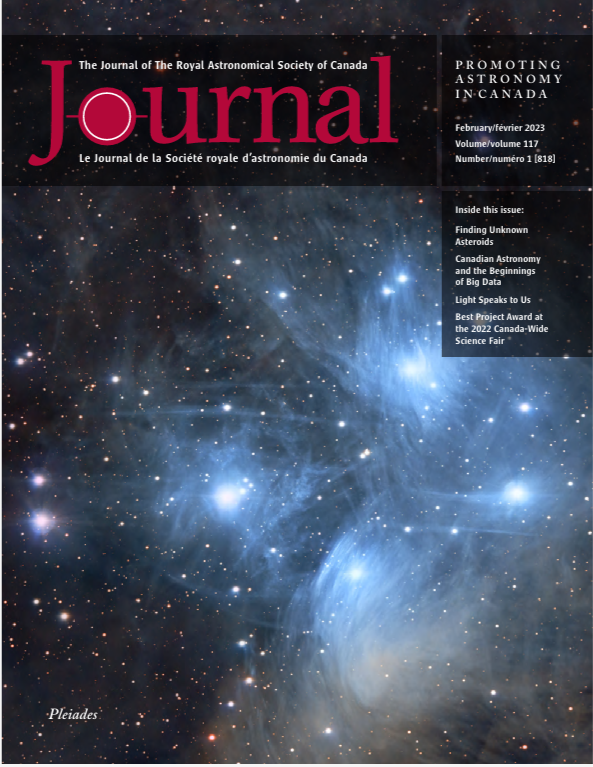
Most near-Earth asteroids large enough to cause regional damage are still undiscovered. In this paper I show how a citizen scientist can help close that gap: using robotic telescopes, open sky-survey data, and Python, I detect moving objects against the fixed background stars, measure their positions (astrometry), and report them to the Minor Planet Center - a reproducible, low-cost pipeline for finding and tracking unknown asteroids.
INVITED TALK · Remote Telescope Webinar
iTelescope.net Webinar: Asteroid Science with Remote Telescope with a focus on DART Mission
Arushi Nath · 30 November 2022
I hosted an iTelescope.net webinar showing how anyone can use robotic telescopes and open data to detect and characterise asteroids, with a focus on measuring the physical effects of NASA's DART impact on the Didymos system.
NATIONAL AWARD - Canada-Wide Science Fair 2022
Canada-Wide Science Fair (CWSF) 2022 Best Project Award
Arushi Nath - 30 May 2022

At the 60th Canada-Wide Science Fair, held virtually from Fredericton with over 350 finalists, my project on detecting unknown asteroids from open sky-survey data won the Fair's Best Project Award, a Gold Medal, Best of Category, Excellence in Astronomy and the Youth Can Innovate Award. I queried ESA's Gaia and NASA's Horizons ephemeris service to mask known objects in images from four telescopes, leaving candidate moving objects behind.
CITIZEN-SCIENCE PROJECT · Asteroid Detection Algorithms
Strengthening Planetary Defence: Detecting Unknown Asteroids using Open Data, Math, and Python
Arushi Nath · 15 April 2022
I took images from 4 telescopes located at different latitudes to cover both hemispheres. I wrote Python algorithms to query European Space Agency's Gaia and NASA/JPL's Horizons ephemeris system to identify the known stars and asteroids in each field. Mean, standard deviation, and histograms created masks to remove known objects. The remaining objects were classified as possible asteroid candidates.
I detected 3 'preliminary' asteroids. Using the telescope's focal length and celestial location, my algorithm's plate-solving ability determined its Right Ascension and Declination. I reported this information by creating a Minor Planet Center report for my images. I have made my code and methodology open-source to crowdsource planetary defence.